
Casos prácticos – Nantes · 2026–2028
Nantes.
Con una área metropolitana de 677 000 habitantes repartidos en 24 municipios, Nantes es líder europeo en transición sostenible y participación ciudadana, además de un laboratorio viviente para la investigación de vanguardia sobre la contaminación atmosférica y acústica.
677,000
Habitantes de Nantes Métropole
24
Municipios metropolitanos
2,530
Muertes por PM2,5 al año
52,340 ha
Territorio
Contexto
Un líder de la región atlántica que se enfrenta a un reto en materia de salud urbana.
Situada en el corazón de la región de Loira Atlántico, Nantes Métropole agrupa a 24 municipios y cuenta con cerca de 677 000 habitantes repartidos en una superficie urbana y rural de 52 340 hectáreas. La Metrópoli se ha sumado a la iniciativa de la UE «100 ciudades inteligentes y climáticamente neutras», impulsada por un enfoque renovado de la participación ciudadana como motor de la acción sistémica en materia de sostenibilidad y de una formulación de políticas mejor fundamentada.
La calidad del aire en Nantes Métropole se considera «media» durante el 78 % del año, «deficiente» durante el 19 %, «mala» durante el 2 % y «buena» solo durante el 1 % (cifras de 2023). Las partículas finas (PM2,5) son, por sí solas, responsables de 2.530 muertes prematuras al año en el departamento de Loira Atlántico. La Política Metropolitana de Salud Pública (2023) se integra en el Plan Local de Calidad del Aire, que a su vez forma parte del Plan Territorial de Clima, Aire y Energía.
La Ley francesa de Clima y Resiliencia establece el objetivo de reducir en un 50 % las emisiones de partículas finas entre 2020 y 2030. Por su parte, el ruido provocado por el tráfico rodado es el que más afecta a los habitantes de la zona de Nantes Métropole; la Métropole publica y actualiza mapas estratégicos de ruido y planes de acción, el último de los cuales se aprobó en julio de 2024 para el periodo 2024-2029.
Ruido del tráfico rodado · La principal carga
Decenas de miles de personas afectadas por el ruido.
Según el método de evaluación de riesgos para la salud establecido en la Directiva europea, se estima que aproximadamente 64 600 residentes se ven afectados de forma significativa por el ruido del tráfico rodado, 7 900 por el ruido ferroviario y 2 900 por el ruido de los aviones. Se calcula que alrededor de 8 300 residentes sufren trastornos del sueño a causa del ruido del tráfico rodado, y que 1 300 personas podrían padecer cardiopatía isquémica atribuible a dicho ruido.
677,000
Habitantes de 24 municipios
52,340 ha
Territorio urbano y rural
78%
Número «medio» de días al año con buena calidad del aire (2023)
Contaminación atmosférica
Debido a la presencia predominante de partículas finas (PM2,5) procedentes del tráfico rodado y de la calefacción doméstica, la calidad del aire de Nantes rara vez alcanza niveles «buenos». La exposición acumulada afecta de manera desproporcionada a las poblaciones más vulnerables.
2.530 muertes prematuras al año atribuidas a las PM2,5 en la región de Loira Atlántico
Contaminación acústica
El ruido del tráfico por carretera, ferroviario y aéreo afecta a decenas de miles de residentes. Más allá de la molestia, la exposición crónica al ruido está relacionada con trastornos del sueño, enfermedades cardiovasculares y una disminución del bienestar.
64,600 los habitantes podrían sentirse «muy molestos» por el ruido del tráfico rodado
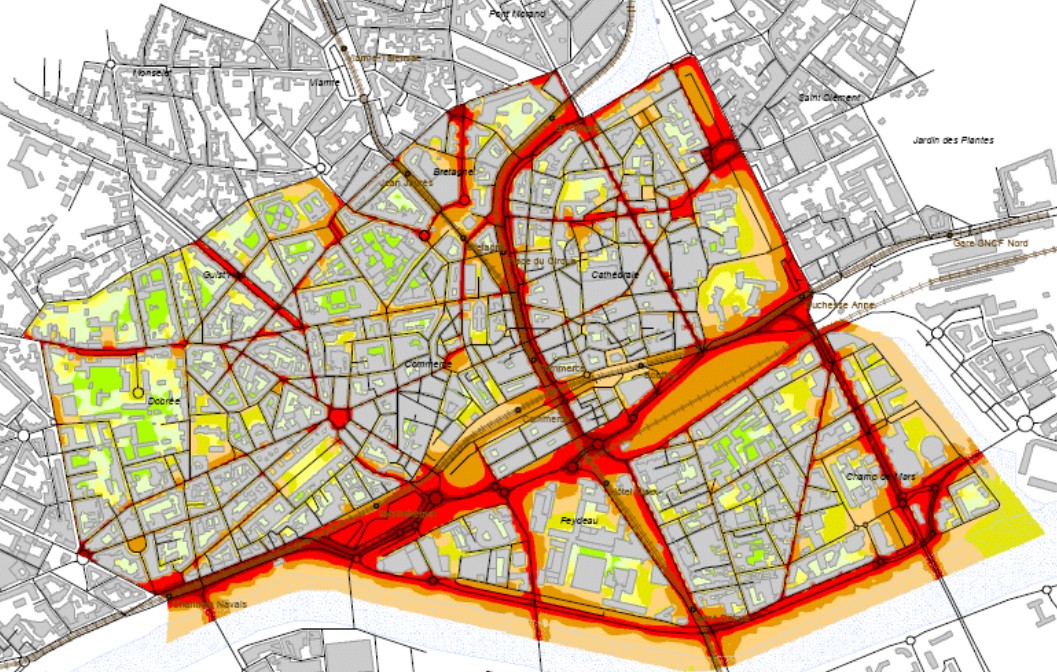
LA CONTAMINACIÓN ACÚSTICA
El ruido es el factor que más
afecta al medio ambiente de los vecinos.
Al aplicar el método de cálculo de los riesgos para la salud establecido en la Directiva europea, la magnitud de la contaminación acústica del tráfico rodado en toda la Metrópoli se pone claramente de manifiesto, lo que explica por qué el ruido ocupa un lugar central en el estudio de caso de Nantes.
- 64,600 residentes que probablemente se vean afectados de forma significativa por el ruido del tráfico rodado
- 8,300 residentes que, según las estimaciones, sufren trastornos del sueño a causa del ruido del tráfico
- 7,900 residentes que se ven muy afectados por el ruido del tren
- 1,300 personas que podrían padecer una cardiopatía isquémica atribuible al ruido del tráfico
OBJETIVOS Y METAS
Tres objetivos fundamentales para una metrópolis más saludable.
La Estrategia Dinámica de Reducción de Emisiones (DAS) de Nantes se ha diseñado en consonancia con los compromisos de la Metrópoli, combinando la ciencia, la participación ciudadana y las medidas políticas.
01
Mejorar la calidad del entorno de vida
Cuantificar los efectos acumulativos sobre la salud de la contaminación atmosférica y acústica combinadas en los habitantes de Nantes, aportando datos que sirvan de base para impulsar intervenciones específicas en las zonas urbanas más afectadas.
02
Convivir con los riesgos: empoderar a los ciudadanos
Hacer que los ciudadanos sean protagonistas de su propia seguridad y salud mediante la integración de datos de ciencia ciudadana en tiempo real, a través de las aplicaciones NoiseCapture y Naonair, en los sistemas de monitorización y de apoyo a la toma de decisiones de PUREPOLIS.
03
Adaptarse al cambio climático
Evaluar los beneficios colaterales de las medidas de «cero contaminación» para el clima, la energía y la salud pública, integrando los resultados del DAS en el Contrato Climático-Urbano y en el Plan Metropolitano de Calidad del Aire.
MEDIDAS PARA LA CONTAMINACIÓN CERO (Zero Pollution Measures)
Tres intervenciones del mundo real bajo la lupa.
PUREPOLIS evalúa la eficacia de tres medidas de contaminación cero ya implantadas en Nantes, analizando sus beneficios colaterales para la salud, el clima y la economía mediante los métodos PR6 para el análisis de la complejidad de las medidas de contaminación cero.
INFRAESTRUCTURA DE DATOS
Una red de seguimiento a varios niveles.
El estudio de caso de Nantes se basa en tres fuentes de datos complementarias, que combinan la infraestructura institucional con los datos generados por los ciudadanos para lograr una cobertura sin precedentes.
HERRAMIENTAS DE PUREPOLIS APLICADAS
El conjunto completo de herramientas en acción.
Cada paquete de investigación principal de PUREPOLIS se implementa y se prueba en València, prestando especial atención a las herramientas de innovación digital que ofrece el ecosistema de ciudad inteligente de primer nivel de la ciudad.
SOCIO LOCAL
Quiénes hacen que todo funcione en Nantes.
Socio principal – Entidad local
Nantes Métropole
Entidad jurídica responsable de la política metropolitana de salud pública, de las medidas de reducción del ruido y la contaminación atmosférica, y de la coordinación general del estudio de caso de Nantes.
Socio técnico – Calidad del aire
Air Pays de la Loire
Responsable de la red de control de la contaminación atmosférica, de la aplicación Naonair y de la base de datos sobre emisiones de gases de efecto invernadero y el clima, lo que permite evaluar los beneficios colaterales de la ZPM en relación con las políticas energéticas y climáticas.
Socio técnico – Acústica
Acoucité
Organización especializada en ruido que presta apoyo a las actividades de seguimiento, organiza eventos colaborativos de cartografía del ruido en el marco de la ciencia ciudadana y contribuye a la elaboración de mapas estratégicos detallados de ruido.
Descubre el otro laboratorio viviente.
Descubre cómo aborda València la contaminación del suelo y del agua tras las inundaciones en L’Albufera, o vuelve al resumen completo del caso práctico.