
Case studies – Nantes · 2026–2028
Nantes.
A metropolitan area of 677,000 inhabitants across 24 municipalities, Nantes is a European leader in sustainable transitions and citizen engagement — and a living laboratory for cutting-edge air and noise pollution research.
677,000
Inhabitants in Nantes Métropole
24
Metropolitan municipalities
2,530
PM2.5 deaths / year
52,340 ha
Territory
Context
An Atlantic leader facing an urban health challenge.
Located in the heart of the Loire-Atlantique region, Nantes Métropole brings together 24 municipalities and nearly 677,000 habitants across an urban and rural area of 52,340 hectares. The Métropole has joined the EU Mission “100 Climate-Neutral and Smart Cities”, driven by a renewed approach to community engagement as a vehicle for systemic sustainability action and better-informed policymaking.
Air quality in Nantes Métropole is considered “average” for 78% of the year, “poor” for 19%, “bad” for 2% and “good” for only 1% (2023 figures). Fine particulate matter (PM2.5) alone is responsible for 2,530 premature deaths per year in the Loire-Atlantique département. The Metropolitan Public Health Policy (2023) is integrated into the local Air Quality Plan, itself embedded in the Climate-Air-Energy Territorial Plan.
The French Climate and Resilience Act sets a target of a 50% reduction in fine particle emissions between 2020 and 2030. Noise due to road traffic, meanwhile, has the worst impact on inhabitants of the Nantes Métropole area — the Métropole publishes and updates Strategic Noise Maps and Action Plans, the latest adopted in July 2024 for 2024–2029.
Road-traffic noise · The leading burden
Tens of thousands affected by noise.
Following the European Directive’s health-risk method, approximately 64,600 residents are likely to be significantly affected by road traffic noise, 7,900 by rail noise and 2,900 by aircraft noise. Around 8,300 residents are estimated to experience sleep disturbance from road traffic noise, and 1,300 people could suffer from ischemic heart disease attributable to it.
677,000
Inhabitants across 24 municipalities
52,340 ha
Urban and rural territory
78%
“Average” air-quality days per year (2023)
Air pollution
Dominated by fine particles (PM2.5) from road traffic and residential heating, Nantes air quality rarely reaches “good” levels. Cumulative exposure disproportionately affects the most vulnerable populations.
2,530 premature deaths / year attributed to PM2.5 in Loire-Atlantique region
Noise pollution
Road, rail and air traffic noise affect tens of thousands of residents. Beyond annoyance, chronic noise exposure is linked to sleep disturbance, cardiovascular disease and reduced wellbeing.
64,600 inhabitants potentially “highly annoyed” by road traffic noise
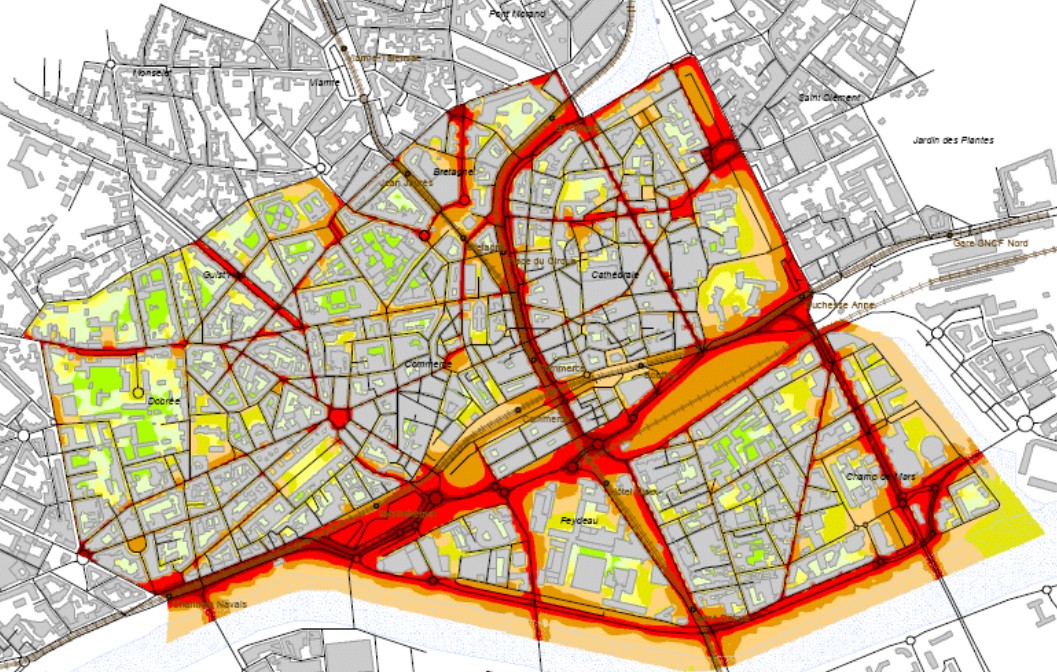
THE NOISE BURDEN
Noise has the worst
environmental impact on residents.
Using the European Directive’s method for calculating health risks, the scale of the road-traffic noise burden across the Métropole comes sharply into focus — and frames why noise sits at the heart of the Nantes case study.
- 64,600 residents likely to be significantly affected by road traffic noise
- 8,300 residents estimated to experience sleep disturbance from road noise
- 7,900 residents significantly affected by rail noise
- 1,300 people who could suffer ischemic heart disease attributable to road noise
OBJECTIVES & TARGETS
Three driving objectives for a healthier metropolis.
The Nantes Dynamic Abatement Strategy (DAS) is designed in line with the Métropole’s commitments — linking science, citizen engagement and policy action.
01
Improve the quality of the living environment
Quantify the cumulative health impacts of combined air and noise pollution on Nantes residents, producing actionable evidence to drive targeted interventions in the most affected urban zones.
02
Live with risks – empower citizens
Make citizens actors in their own safety and health by integrating real-time citizen science data, via the NoiseCapture and Naonair apps, into PUREPOLIS monitoring and decision-support systems.
03
Adapt to climate change
Evaluate the co-benefits of Zero Pollution Measures for climate, energy and public health, integrating DAS outcomes into the Climate-City Contract and Metropolitan Air Quality Plan.
ZERO POLLUTION MEASURES
Three real-world interventions under the microscope.
PUREPOLIS evaluates the effectiveness of three existing Zero Pollution Measures already implemented in Nantes — measuring their health, climate and economic co-benefits using the PR6 Methods for ZPM Complexity Analysis.
DATA INFRASTRUCTURE
A multi-layered monitoring network.
The Nantes case study draws on three complementary data streams, combining institutional infrastructure with citizen-generated data for unprecedented coverage.
PUREPOLIS TOOLS APPLIED
The full toolkit in action.
Each core PUREPOLIS research package is deployed and tested in Valencia, with special emphasis on the digital innovation tools enabled by the city’s world-class smart-city ecosystem.
LOCAL PARTNER
Who makes it happen in Nantes.
Lead Partner – Municipal authority
Nantes Métropole
Legal entity responsible for the Metropolitan Public Health Policy, noise and air pollution mitigation measures, and overall coordination of the Nantes case study.
Technical Partner – Air quality
Air Pays de la Loire
Responsible for the air pollution monitoring network, the Naonair application, and the GHG emissions and climate database — enabling assessment of ZPM co-benefits with energy and climate policies.
Technical partner – Acoustics
Acoucité
Noise-expertise organisation supporting monitoring activities, organising collaborative citizen-science noise-mapping events, and contributing to the development of detailed strategic noise maps.
Explore the other living lab.
See how Valencia tackles post-flood soil and water contamination in L’Albufera — or return to the full case-study overview.